1Why a Price Increase Is Easy to Miss
A subscription price rarely jumps by a lot in one go. It moves by a dollar or two, or a small percentage, which is exactly small enough to slide past you on a bank statement you are scanning quickly rather than reading line by line.
The charge still comes from a company you recognize, for a service you still use, on roughly the day you expect it. Nothing about the transaction looks wrong, so nothing about it makes you stop and check the actual amount against what you signed up for.
This is a different problem from a forgotten subscription you never use. You know you have this subscription and you are using it. You just have no record of the original price to compare the new charge against, so the increase never registers as a decision anyone should have gotten your say on.
Did you know? Because autopay removes the step where you approve each charge by hand, a price increase can go through without you ever seeing a number you would have questioned if you had to type it in yourself.
2How You're Actually Supposed to Be Notified
Rules about warning you before a price increase exist, but they are not the same everywhere, and they only apply to certain kinds of subscriptions. California's Automatic Renewal Law, strengthened by amendments that took effect in mid-2025, requires a business to notify you of a price change on an auto-renewing subscription at least seven days and no more than thirty days before the new price is charged, along with a clear way to cancel that you can keep a copy of.
In the EU, consumer protection rules require that a significant price increase be disclosed to you in writing with a real chance to walk away before it takes effect, and the terms you agreed to at signup have to spell out how renewal and pricing work in the first place, not bury it in fine print you never saw.
Note: not every state or country has a specific price-increase notice law, and even where one exists, it usually only covers auto-renewing consumer subscriptions, not every kind of recurring charge. When in doubt, the company's own terms of service are the actual source of truth for what notice they owe you.
3Where the Notice Actually Shows Up
A required notice does not mean a notice you will actually see. Companies commonly send it as one more line inside a general "we've updated our terms" email, a banner inside the app you rarely open, or a message to an inbox you switched away from years ago and forgot to update.
- An email with a subject line about "updated terms" or "policy changes" rather than the word "price"
- A one-line mention inside a longer account settings or app update notification
- A notice sent to an old email address still on file from when you first signed up
- A message that only appears if you log into a web dashboard you normally never visit
None of this is necessarily against the rules. A company can meet its legal notice requirement and still send something you are highly unlikely to open, read, and connect to a specific dollar amount three weeks later when the new charge actually lands.
4The 'Just a Dollar More' Trick
Large, sudden price jumps get noticed and generate cancellations and complaints. Small, repeated ones generally do not, which is exactly why streaming services, software tools, and gym or fitness apps have leaned toward raising prices in smaller steps over the past several years rather than one big number at once.
Example scenario: a streaming plan you signed up for at one price raises its rate by a small amount roughly once a year. Each individual increase feels too minor to bother canceling over. Compare the price today against the receipt from when you first subscribed, and the total gap can be larger than you would have accepted if it had all happened as one increase.
Note: this is not automatically bad faith. Costs genuinely rise for the businesses providing these services too. The issue is not that prices go up, it is that most people have no easy way to notice when theirs did.
5How Fast Small Increases Add Up
One subscription creeping up by a small amount each year is easy to shrug off. The real cost shows up when you add that same pattern across every recurring charge you have, streaming, software, a gym, cloud storage, and a few app subscriptions you barely think about.
Example scenario: five different subscriptions each raise their price by a small amount within the same twelve months. None of the five increases would have been worth canceling over on its own. Added together across your whole subscription list, the total increase can be the size of an entire extra subscription you never actually chose to add.
This is already happening in 2026. Netflix, Spotify, YouTube Premium, Peacock and others all raised US prices this year, as our 2026 streaming price increase tracker shows, along with the Disney+ and Hulu price increase that reaches existing subscribers from October 21.
A price increase you never noticed on five different subscriptions adds up to the exact same cost as one brand new subscription you never agreed to.
6What to Do the Moment You Spot an Increase
Step 1: Confirm it against your original receipt or signup email. Search your inbox for the confirmation you got when you first subscribed. This gives you a real number to compare against, instead of relying on memory.
Step 2: Decide if the new price still makes sense for how much you use it. A service you use daily might still be worth the higher price. One you barely open is a much easier call to make once the price no longer feels small.
Step 3: Look for a lower tier or an annual option before canceling outright. Some companies raise the price of the plan you are on while leaving a lighter tier, or a discounted annual version of the same plan, at a lower effective cost.
Step 4: Cancel before the new price bills if you decide to walk away. If you plan to leave, the sequence matters. For the exact steps across app stores, UPI, and card-billed subscriptions, follow our subscription cancellation checklist.
7Asking for Your Old Price Back
Asking a company to keep you on your old rate costs nothing and works more often than people expect, especially if you have been a customer for a long time, you are on an annual plan, or the increase caught you off guard with little real notice.
- Contact support directly rather than canceling through a self-serve menu, since a cancellation flow rarely has the option to negotiate
- Mention how long you have been a customer and that you only noticed the change now
- Ask specifically whether a loyalty rate, an annual discount, or a lower tier is available instead of the new price
- If the increase happened alongside a payment problem, such as a declined card, ask if the old rate can be restored since the cancellation was not really a choice to leave
A price you lose because of a card issue rather than a deliberate cancellation is worth reading up on separately, since a declined autopay payment can end a subscription and its old price at the same time, without you ever choosing to leave.
8Build the Habit: Compare Every Charge to the Original
Catching one price increase after the fact is useful. Catching all of them going forward depends on having something to compare a new charge against, which means writing down the original price the moment you sign up for anything.
Set a recurring reminder, once a month or once a quarter, to pull up your bank and card statements and check each recurring charge against the amount you expect. This is the same habit behind a full subscription spending audit, just repeated often enough that an increase gets caught within weeks instead of years.
Annual subscriptions deserve extra attention here, since you only see the charge once a year and have the least chance to notice a change. If you have any yearly plans, it is worth pairing this habit with our guide on tracking every annual renewal date.
9Catching Every Increase Before It Bills You
The real fix is not reading every email a company sends you. It is having the original price for every subscription sitting next to the current one, so a changed number is obvious the moment it happens instead of buried in a statement with thirty other lines.
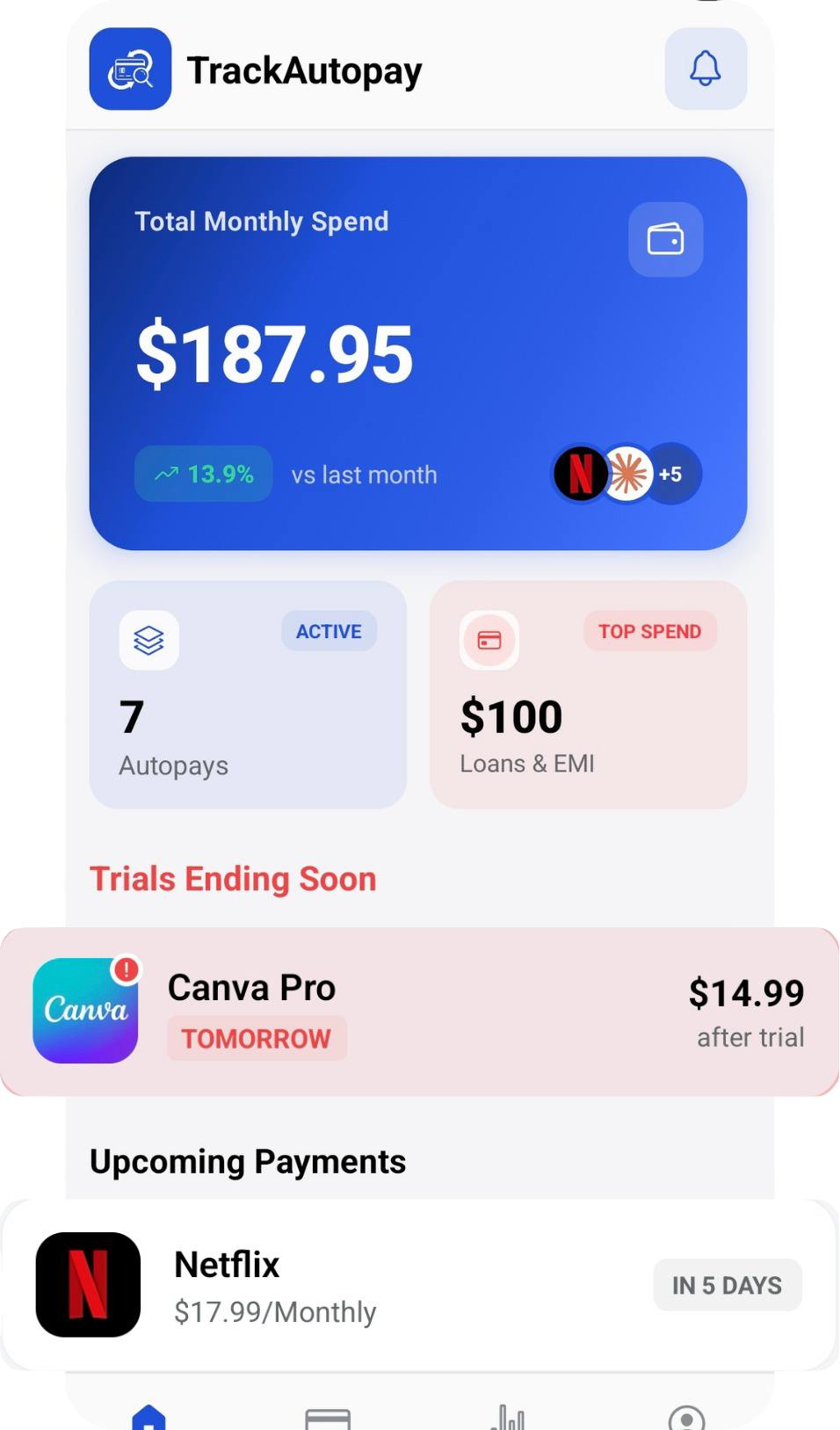
TrackAutoPay gives you one place to log every subscription with its starting price and due date, so you can glance at your dashboard and see exactly which charge changed, rather than relying on a notice email you may never see.
Never Miss a Price Increase Again
Log every subscription with its original price and see the moment a charge changes, instead of finding out months later.