1What Changed on 1 August 2026
Most of the subscription law news this year has been about rules that are still coming. This one is different. Amendments to British Columbia's Business Practices and Consumer Protection Act took effect on 1 August 2026, which means they are in force now, not scheduled.
The amendments do four things that matter to anyone paying for a subscription: they define what counts as a subscription contract, they require advance notice before certain automatic renewals, they limit automatic renewal on short contracts, and they restrict a business from rewriting the terms on its own.
Note: consumer protection in Canada is mostly provincial. These specific requirements are British Columbia law. Other provinces have their own rules on auto-renewal and cancellation, and they are not identical.
2#1: Which Contracts Actually Count
A subscription contract here means a future performance contract for goods or services supplied on a continuing basis, where the total price is $50 or more. That definition does more work than it looks like it does.
Total price, not monthly price, is the test. A service at a few dollars a month over a year clears $50 comfortably. So most streaming plans, software plans, meal boxes, and gym memberships sit inside the definition rather than outside it.
Below that figure, the specific subscription requirements do not apply, though the rest of consumer protection law still does. Small recurring charges are exactly the ones people forget, so this is a real edge of the protection worth knowing about.
3#2: The Renewal Notice You Should Get
This is the headline change. If a service subscription renews automatically for a term of more than 60 days, the business has to notify you between 30 and 60 days before the renewal date.
The two-sided window is the clever part. A minimum of 30 days means you get real time to cancel rather than a notice that arrives the day before. A maximum of 60 days stops a company from sending it so far ahead that you have forgotten by the time the charge lands.
In practice, this mostly affects annual plans, which are the ones people lose track of most reliably. A yearly charge only gives you one chance a year to notice it, and until now that chance often came after the money had gone.
For auto-renewing terms longer than 60 days, BC businesses must now tell you between 30 and 60 days before the renewal date.
4#3: Short Terms and Cancelling Freely
Monthly subscriptions get a different treatment. For contracts with a term of 60 days or less, automatic renewal is not permitted unless you can cancel at any time, before or after the renewal date, with no charge or penalty.
That trade is sensible. Nobody wants a notice every single month for a $12 service. Instead of notices, you get the ability to walk away at any point without being held to the term you just rolled into.
Put together, the two rules cover the two ways subscriptions catch people out. Long terms get advance warning. Short terms get a free exit.
| Contract term | What the business must do |
|---|---|
| More than 60 days | Notify you 30 to 60 days before renewal |
| 60 days or less | Allow cancelling any time, no penalty |
| Total price under $50 | Outside the subscription definition |
5#4: Quiet Term Changes Are Restricted
Plenty of subscription contracts have long contained a line saying the company may change the terms at any time. The amendments make such a clause void unless the business clearly set out, at the time you signed, exactly which terms could change.
There is a further limit on top of that. Even where changes are allowed, a business cannot on its own change terms about cancellation, returns, exchanges or refunds in a way that adds to your obligations or reduces its own. In other words, it cannot make leaving harder after you have joined.
Non-compliance carries fines of up to $50,000 for a business and up to $5,000 for an individual, which is a meaningful reason for companies operating in the province to actually send those notices.
6#5: What These Rules Do Not Do
They are provincial, so a reader in Ontario, Alberta or Quebec is covered by a different set of rules with different notice requirements and different cancellation rights. Check your own province rather than assuming the BC timing applies to you.
They also do not tell you what you are subscribed to. A notice only helps if it reaches you and you read it, and renewal emails land in the same inbox as everything else a company sends. Many go unopened for the same reason most marketing email does.
Alongside the provincial rules, the federal Competition Act prohibits deceptive marketing practices nationally, and the Competition Bureau has repeatedly warned about offers that lead into recurring charges. That is a national backstop rather than a notice requirement.
7#6: If the Notice Never Arrives
A renewal you were not warned about is worth pushing back on. Work through it in this order.
- Search your inbox, including the promotions and spam folders, for anything from the company in the two months before the charge. Notices do get sent and missed.
- Check the renewal term and the total price in your account, so you know whether the contract is the kind these rules cover.
- Write to the company. State that no renewal notice arrived, ask them to cancel, and ask for the renewal charge back.
- Keep the whole exchange in writing. An email trail is worth far more later than a phone call nobody recorded.
- If they refuse and you believe the contract is covered, Consumer Protection BC handles complaints under this Act.
- Only after that, take it to your bank or card issuer as a disputed charge, with your written record attached.
If it reaches the bank stage, our guide on disputing a charge you did not agree to covers what to say and what evidence matters.
8#7: Your Own Reminder Still Matters
A renewal notice is a good protection and a poor system. It depends on the company sending it, the email reaching you, and you opening it during a specific 30-day window. Any of those three can fail without anyone noticing until the charge appears.
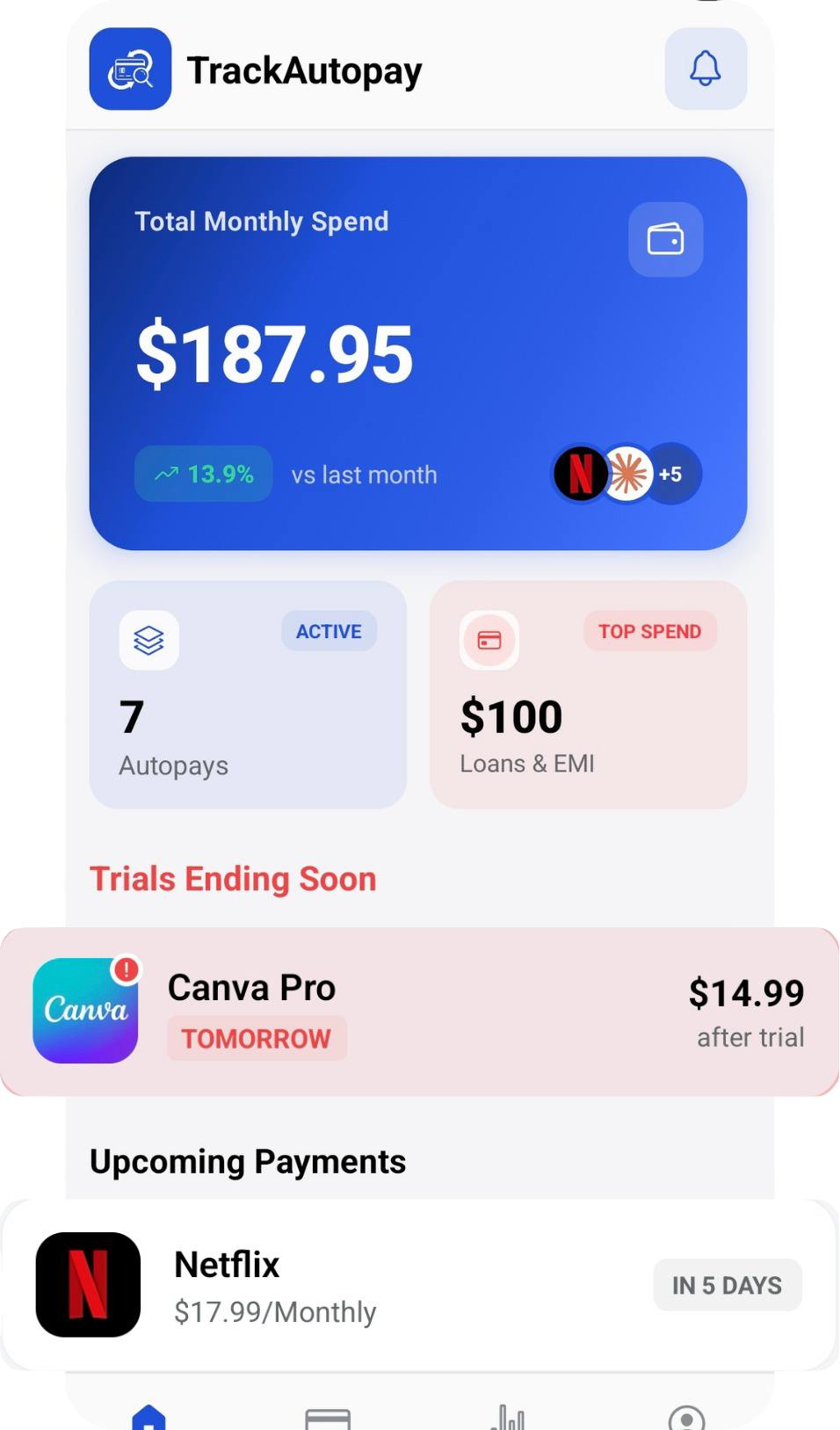
A reminder you control fails for none of those reasons, and it works the same whichever province you live in. Add each subscription to TrackAutoPay with its price and renewal date, and treat the company's notice as a second confirmation rather than your only warning. Our guide on tracking annual renewal dates covers why yearly plans need this most.
Do Not Rely on the Renewal Email
Keep every subscription and renewal date in one list, with your own reminder before each charge arrives.