2Why You Need to Act Fast
You should tell your bank or credit union right away as soon as you see an unauthorized payment, or a payment made after you revoked authorization. Don't wait to see if it happens again or hope the company will notice and refund it on its own.
Acting quickly matters for two reasons. First, the law that protects you for unauthorized bank account transfers is time-sensitive, the sooner you notify your bank, the stronger your position. Second, the longer an unauthorized charge sits unreported, the more likely it is to repeat next month, or the harder it becomes to remember exact dates and details when you do call.
- Report it the same day or as soon as you notice it
- Don't wait for a second charge to "confirm" the pattern
- Write down the date you first saw the charge
- Call your bank or card issuer directly, don't rely only on the merchant
3What to Say to Your Bank or Card Issuer
When you call, keep it simple and factual. You don't need legal language, just clear facts in order.
A simple script to use:
- State the exact charge: the merchant name, the amount, and the date it posted.
- Say clearly whether you never authorized it, or whether you cancelled or revoked authorization before this charge, and give the date you cancelled.
- Ask them to open a dispute or a claim for an unauthorized transaction.
- Ask whether they can block future charges from that merchant.
- Ask for a reference or case number, and write it down.
- Ask what happens next and how long the investigation usually takes.
Note: Be specific about dates. Saying "I cancelled this a while ago" is weaker than saying "I cancelled on this date, and here is the confirmation email." The more exact you are, the faster your bank can act.
4Documentation to Keep
A dispute goes faster and is more likely to succeed when you can back it up. Before you call, gather what you have.
- A screenshot of the charge on your bank or card statement
- The cancellation confirmation email, if you cancelled a subscription
- The exact date you cancelled or revoked authorization
- The exact date the unauthorized charge posted
- Any messages or emails you exchanged with the merchant
- Notes from any prior calls, including who you spoke to and when
Keep all of this in one place, a folder on your phone or a notes app works fine. If the merchant charges you again while your dispute is open, you will want to add that new date and screenshot too.
5Realistic Dispute Timelines
Timelines depend on whether the unauthorized charge came out of a bank account or a credit card, so it helps to know the difference before you call.
| Charge Type | When to Notify |
|---|---|
| Unauthorized bank account transfer | Right away, as soon as you see it |
| Credit card charge dispute | Within 60 to 120 days of the statement date |
For a bank account, notifying your bank right away is what protects your right to get the money back, waiting reduces that protection. For a credit card, most issuers give you a window of 60 to 120 days from the statement date the charge appeared on, but the exact number depends on your card issuer, so check your cardholder agreement or ask when you call.
Federal law gives you the right to dispute and get your money back for unauthorized bank transfers, as long as you notify your bank in time, so the moment you spot the charge is the moment to act.
6What Happens After You File a Dispute
Once you report the charge, your bank or card issuer opens a formal dispute or claim. Here is roughly what to expect.
Typical steps after you file:
- Your bank or card issuer logs the dispute and gives you a case or reference number.
- Many banks and card issuers apply a provisional credit, a temporary refund, back into your account while they investigate.
- The bank investigates, this can include contacting the merchant and reviewing your evidence.
- You may be asked to send in your documentation: screenshots, cancellation emails, and dates.
- The bank tells you the outcome. If the charge is confirmed unauthorized, the provisional credit becomes final. If the investigation finds the charge was valid, the credit can be reversed.
Note: Not every dispute qualifies for provisional credit automatically, and rules vary by bank and by whether the charge came from a bank account or a credit card. Ask directly when you file whether a provisional credit applies to your case.
7Staying Ahead of Unauthorized Charges
The best way to catch an unauthorized charge quickly is to know what you are supposed to be charged for in the first place. When you have a clear list of your active subscriptions and recurring payments, a charge that doesn't belong stands out right away instead of blending into a long statement. Our guide on finding every automatic payment across your accounts walks through exactly how to build that list.
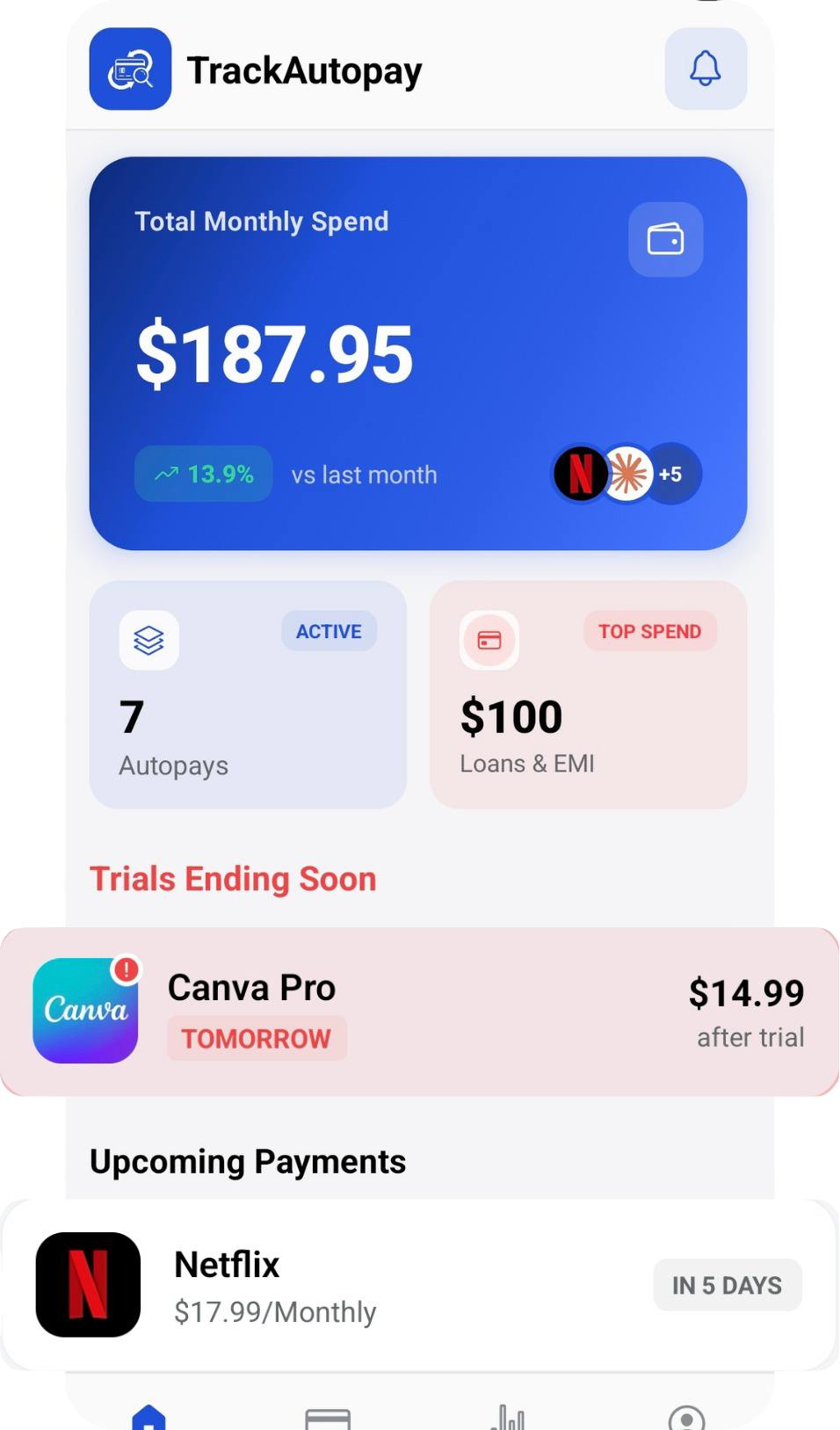
TrackAutoPay helps you keep track of your recurring payments and subscriptions in one place, so it's easier to notice something unexpected and act on it fast, while the details are still fresh and your dispute window is still open.
Know Every Charge Before It Surprises You
Track your subscriptions and recurring payments in one place, so an unauthorized charge stands out immediately.