1This Isn't About Forgetting to Cancel
Most advice about autopay and overspending treats it as a memory problem. You forgot to cancel a free trial, you forgot an annual renewal was coming, you forgot a subscription even existed. The fix, in that framing, is a better list: find every charge, write it down, cancel what you don't use.
That advice is real and useful, and this site has plenty of it. But it skips over a more basic question. Even for the subscriptions you remember perfectly well, the ones you could name from memory right now, why do they get so much less scrutiny once they run on autopay than they would if you had to pay for them by hand every single time?
That question has an answer, and it comes from decades of behavioral-economics research on how people experience the act of paying. Paying for something by hand carries a small, real psychological cost. That cost does useful work: it is one of the few natural brakes an ordinary person has on how much they spend. Automating a payment does not just make it easier to forget a charge exists. It releases that brake, on purpose, for every charge it touches, whether you remember it or not.
This guide walks through the specific mechanisms behind that: the pain of paying, decoupling, default-option bias, and what researchers call salience decay, and why they add up very differently across a stack of subscriptions than they do for a single loan or utility bill. If you want the practical checklists for finding and cancelling what you already have, our guides on finding every automatic payment and stopping one for good cover that in detail. This one covers the why.
2The Pain of Paying: The Brake Autopay Switches Off
In the late 1990s, economists Drazen Prelec and George Loewenstein described a simple idea that has shaped how researchers think about spending ever since. Every purchase, they argued, delivers two things at the same time: the pleasure of getting what you paid for, and a small psychological cost from watching money leave your hands. They called that second part the pain of paying.
The pain is not really about whether you can afford something. It shows up whether your account is full or nearly empty, because it is a mental cost, not an accounting one. It is the half-second of hesitation before you buy something you don't need, the reason a wallet of cash spent on a night out feels heavier than the same amount spent on a card. The discomfort does not need to be large to work. It just needs to be present at the moment you decide whether to spend.
A well known study puts a number on how much that discomfort matters. Researchers at MIT auctioned identical tickets to a Boston Celtics game to two groups of bidders. One group was told they would pay in cash if they won. The other was told they would pay by credit card. The tickets were exactly the same. The only difference was how much pain the buyers expected to feel when the bill came due.
The result: the credit-card bidders bid almost twice as much, on average, for the same tickets. Nothing about the product changed. What changed was how painful paying for it felt.
A credit card already dulls that pain compared to cash, since you don't see money leave in the moment. Autopay goes further than a credit card ever could, because there is often no moment at all: no swipe, no tap, no bill to open and approve. That is the subject of the next section.
In a classic MIT auction study, bidders told they'd pay by credit card bid almost twice as much for the exact same tickets as bidders told they'd pay cash, simply because a less painful way to pay changes what feels affordable.
3Decoupling: Why Removing the Moment Changes What You Spend
Prelec and Loewenstein's later work gave a name to what happens when the act of paying gets separated in time from the act of deciding to buy: decoupling. Cash is the most coupled experience there is, you hand over money the instant you get something back. A credit card decouples spending a little: you buy now, and you feel the cost later when the statement arrives. Autopay decouples spending almost completely. The decision to keep paying for something and the moment the money actually leaves your account can sit months apart, and after the first signup, there may be no real decision point left at all.
This matters because the pain of paying appears to depend on paying being something you actively notice. Once paying stops being an event, an entire category of spending stops registering as spending. It starts to feel less like a choice you keep making and more like a fixed fact about your life, closer to your rent than to a purchase.
Example scenario: two people sign up for the same $15-a-month service. One re-enters their card details every renewal and opens the receipt email each time. The other sets it to autopay on day one and never sees a receipt again. A year later, the first person has actively re-decided whether the service is worth it twelve separate times. The second person has decided exactly once, on the day they signed up, and never again since.
Neither person forgot the subscription exists. The difference isn't memory. It's how many times the cost was ever put back in front of a decision.
4Default-Option Bias: The Path Merchants Push You Toward
At nearly every subscription signup, autopay or auto-renew is already selected for you. Turning it off takes an extra click, sometimes several, often buried in account settings you have to already know exist. That is not an accident. It is built on one of the most consistently replicated findings in behavioral economics: whatever is set as the default option is what most people end up keeping, because changing a default takes effort and accepting it takes none.
The clearest demonstration of this comes from an unrelated area entirely: retirement savings. A widely cited study of a large U.S. employer found that when new hires were automatically enrolled in a 401(k) plan by default, instead of having to sign up themselves, participation jumped sharply. Just as striking, most of the employees who were auto-enrolled simply kept the default contribution rate and default investment fund, even though almost none of the employees who joined before automatic enrollment had picked that same combination on their own.
People weren't lazier after the policy changed. The default itself did the deciding. Subscription checkout pages use the exact same mechanism, just pointed the other way. A company that sets autopay as the default keeps more customers on it, not because those customers evaluated autopay and chose it, but because very few people ever go back and unmake a choice they never consciously made in the first place.
5Salience Decay: Why a Charge You Don't See Stops Registering
The first time an automatic charge hits your account, you probably notice it. You might check the amount against what you expected, maybe even open the receipt. By the third or fourth cycle, it blends into a bank statement full of other line items you're also not reading closely. Psychologists have a plain word for this: habituation. A signal that once caught your attention eventually stops registering at all, simply because it keeps repeating without anything changing.
This isn't only something that happens to you passively. Economists who study pricing, notably Xavier Gabaix and David Laibson, have shown that in competitive markets, companies have a real incentive to keep certain costs, especially the ones that show up after the initial purchase decision, harder to notice and easier to increase. A price rise that happens before you buy something gets compared and scrutinized. A price rise that happens on a charge you've already stopped reading closely does not.
Put together, this is why so many services make it easy to turn autopay on at signup and comparatively harder to review, downgrade, or cancel later. Your inattention isn't a side effect the company has to work around. Once a charge is on autopay, it's genuinely worth more to whoever is charging you, precisely because you've stopped looking at it.
6Subscriptions vs. Loans and Utility Bills: Why It Compounds Differently
Not all autopay carries the same risk, and it's worth being specific about that. A loan installment or a utility bill on autopay is a single, well-defined amount: fixed, or tied to something you can actually observe, like electricity used. There's a natural ceiling to it. A loan eventually gets paid off. A utility bill tracks real usage you could check if you wanted to. Decoupling and salience decay still apply, but there's only one payment relationship to lose track of, and its size doesn't quietly grow on its own.
A subscription portfolio is a different shape of problem. Each subscription is its own separate decoupling event and its own separate slide into salience decay, running in parallel. The total isn't one number that gradually goes numb, it's many numbers, each independently going numb on its own schedule. And the count of them tends to grow over time, through new signups, converted free trials, and shared plans, while old ones rarely get proactively removed, because removing one requires exactly the kind of active, coupled decision this whole mechanism trains you out of making.
This isn't just a theory. A survey of U.S. consumers by the research firm West Monroe found that 89% underestimated how much they were spending on subscriptions each month, and two in three were off by more than $200 a month. The real average came out to $273 a month, up from $237 a few years earlier, even as people's own guesses about their spending went down over the same period. That gap doesn't come from any single subscription being deceptive. It comes from a growing number of separately decoupled charges, each easy to individually justify and each too small on its own to trigger the brake that would normally make you question it.
7Recoupling: Getting the Brake Back Without Losing the Convenience
The fix isn't to turn off autopay for essential bills. That reintroduces exactly the risk autopay is good at solving: a missed rent payment, a late fee, a ding to your credit score for a bill you'd have paid anyway. The fix is what this guide will call recoupling, deliberately putting a review moment back in front of a charge, on your own schedule, instead of never.
Set a recurring monthly review. Give yourself 5 to 10 minutes once a month to look at every autopay and subscription you have, one at a time, and ask a simple question: would I sign up for this today, at this price, if I were starting from zero? This recreates a version of the decision autopay skipped, on a schedule you control instead of never.
Log it the moment you turn autopay on, not after. When you enable autopay for something new, write it down somewhere you'll actually look again, not just in a confirmation email you'll never reopen. That small act of logging is itself a form of coupling, it puts a record of the decision somewhere your attention will actually pass by later.
One caution: this has to be recurring, not a one-time cleanup. A single audit gives you a clean list for a week. Salience decay resets the moment you stop looking, which is exactly why the review has to be a habit, not an event.
8Putting Recoupling on Autopay Itself
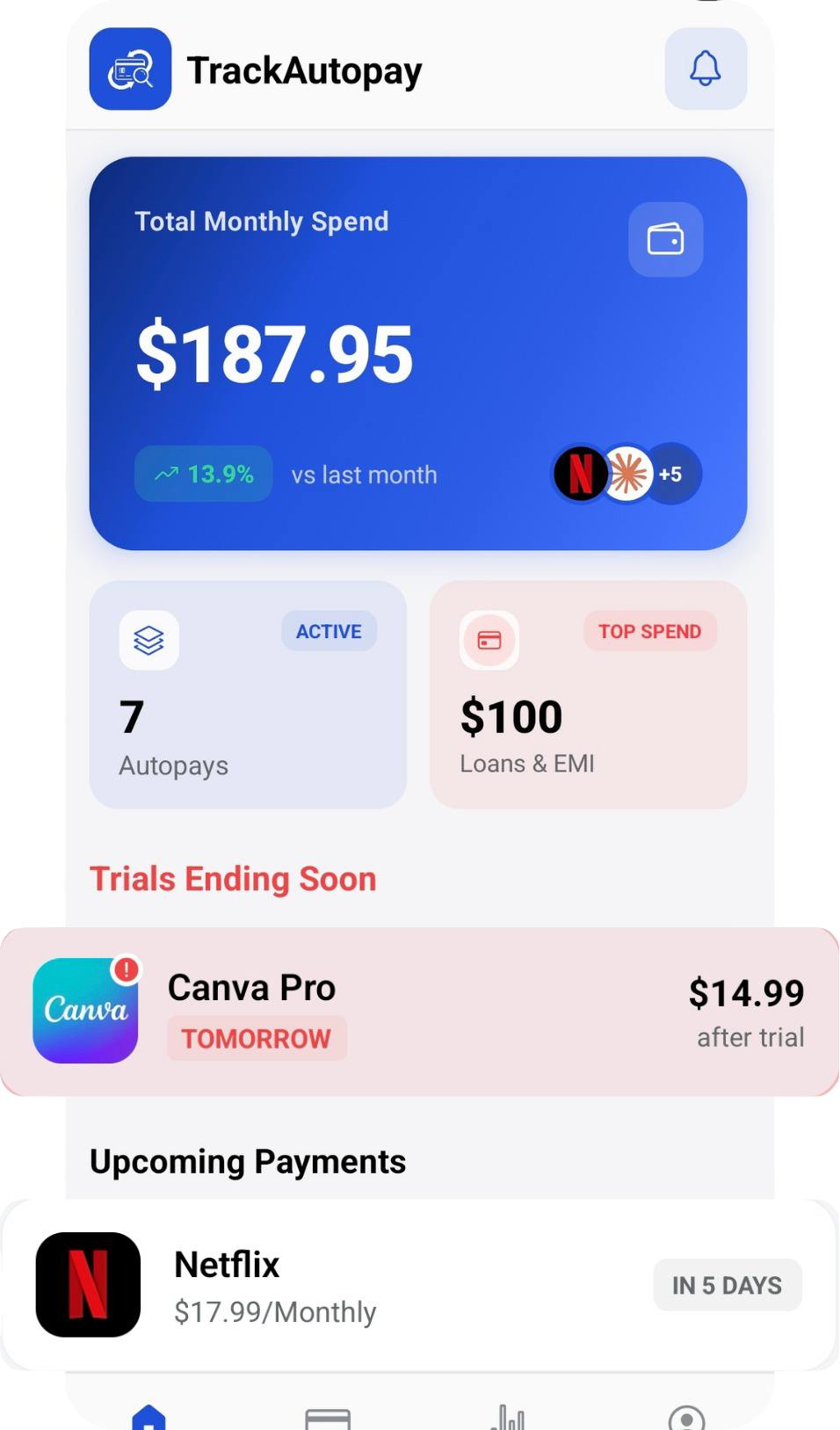
The easiest way to make a monthly review actually happen is to stop relying on memory or scattered bank statements to run it. TrackAutoPay gives you one dashboard where you log every autopay and subscription yourself, with renewal reminders before each charge, so the review this guide describes has somewhere to happen instead of staying a good intention.
It doesn't try to make the decision invisible again in a different way. It puts every recurring charge back in front of you, on a schedule, so the pain of paying gets a fair chance to do its job even after the checkout screen is long gone.
Keep the Pain of Paying Working for You
Log every autopay and subscription in one place, get reminded before each renewal, and see exactly what you're paying for before it becomes background noise.