1Why a Foreign-Priced Subscription Costs More
A lot of subscriptions are priced in one currency no matter where you live. Streaming platforms, AI tools, cloud storage, and many software subscriptions bill in US dollars or euros by default, even if your card was issued in India, the UAE, Canada, Australia, or a country that uses neither currency.
When the currency on the charge does not match the currency your card is denominated in, your bank or card network has to convert it. That conversion is a real cost, and it gets added before the charge ever reaches your statement.
The number you saw on the pricing page, say $9.99, is usually just the price in the merchant's currency. What actually leaves your account is that amount converted at a rate you did not pick, plus whatever fee your card charges for making a cross-currency purchase in the first place.
Did you know? A foreign transaction fee is based on the currency of the charge, not the location of the company. A subscription billed in dollars can trigger the fee even though you never left home and the company may even have a local office in your country.
2The Three Places the Extra Cost Comes From
Up to three separate things can each add a small cost to the same charge, and most statements don't separate them out, so it looks like a single number instead of three.
The issuer's foreign transaction fee
This is a fee your card issuer charges for any purchase in a currency other than your card's home currency, usually somewhere between 1% and 3% of the charge. It applies to the transaction itself, so it shows up whether or not you ever chose a currency at checkout.
The card network's own conversion rate
Once the fee is applied, Visa, Mastercard, or another network converts the amount using its own daily exchange rate. This part sits close to the real market rate but is not identical to it, and it's built into every cross-currency charge whether or not your card carries a foreign transaction fee.
Dynamic currency conversion (DCC)
Some payment pages ask you to choose your own currency at signup instead of the merchant's. Pick your home currency and the merchant's payment processor converts the charge right then, at its own rate. That rate is generally less favorable than the one your own card issuer would apply, and it usually carries a markup on top.
3Where This Quietly Shows Up
This is not limited to one kind of subscription. It hits any recurring charge billed in a currency your card was not issued in.
- Streaming and entertainment subscriptions billed directly by a company based outside your country
- AI tools and productivity software priced and billed in US dollars, regardless of your billing address
- Cloud storage, developer tools, and hosting plans billed in US dollars or euros
- Apps or games sold through a store that bills in a different currency than the one your card uses
- An annual plan billed once a year in a foreign currency, where the whole year's fee is converted in one go
None of this usually shows up as its own line item. It's folded into the same charge you already expect, so unless you compare the amount charged in your currency against the price you were originally shown, nothing on your statement flags that a fee was applied at all. This is a different problem from a subscription you forgot to cancel. You know exactly what you're paying for here, you just don't have visibility into the extra cost added on top of a price you already agreed to.
4What a Foreign Transaction Fee Typically Costs
Foreign transaction fees are not universal, but the range is well documented across card issuers. Industry data on credit card fee structures consistently puts the fee somewhere between 1% and 3% of each charge, with the average sitting close to 1.5%. Roughly one in four credit card offers charges no foreign transaction fee at all.
| Card Type | Typical Foreign Transaction Fee |
|---|---|
| Standard consumer credit card | 1% - 3% per charge |
| Premium or travel-focused card | Often 0% (marketed as no foreign fee) |
| Business credit card | Commonly 2.7% - 3% per charge |
| Debit card | Varies by bank, often the same 1% - 3% range |
Note: these figures come from broad, publicly reported data on card fee structures, not a specific bank. Your exact fee depends on your own card issuer and card type, and the only way to know your number for certain is to check your cardholder agreement or the fee schedule your bank publishes.
The average foreign transaction fee sits around 1.5% of each charge, small enough to disappear inside one subscription bill and large enough to add up across every renewal for as long as you keep paying.
5The Currency Choice You Only Make Once
Some payment pages, especially ones run by larger platforms and payment processors, ask you to choose a currency the moment you subscribe. Pick your home currency and the merchant's payment processor converts the charge itself, right then, using its own exchange rate instead of leaving the conversion to your card issuer. This is called dynamic currency conversion, or DCC.
The rate used for DCC is typically less favorable than the rate your own card issuer would apply, and it usually carries a markup on top. For a one-time purchase, that's a single small cost. For a subscription, the same currency choice you made once at signup applies to every renewal after it, so a slightly worse rate repeats for as long as you keep paying.
Note: if a payment page gives you a choice between paying in the merchant's currency and paying in your own at signup, letting your own card issuer handle the conversion is usually the better default, though the exact difference is not the same for every card and provider.
6How Much This Adds Up Over a Year
Example scenario: you subscribe to a streaming service, an AI tool, and a cloud storage plan, all billed in US dollars, on a card with a 3% foreign transaction fee. Individually, each fee might only be a small amount added to a bill of a few dollars. Added up across three subscriptions charged every month for a year, that same percentage turns into a total you would likely have questioned if it had ever been presented as a single yearly charge.
Annual plans make this easier to notice, since the whole year's fee lands in one conversion instead of twelve small ones. Monthly plans spread the same total out so thin that it rarely triggers a second look, which is exactly why it survives so long unexamined. If you prefer annual billing to save on the base price, pair this with our guide on tracking every annual renewal date, since a foreign-currency renewal is one of the easiest kinds to miss entirely.
7How to Check What You're Actually Paying
Step 1: Compare the charge on your statement to the price you were originally quoted. Convert the price shown on the merchant's website at today's exchange rate and see how far off the actual charge on your statement is. A gap larger than a percent or two usually means a fee, a conversion markup, or both.
Step 2: Look for a line labeled "foreign transaction fee," "cross-border fee," or similar. Some banks show it as a separate line on the statement, others fold it silently into the total charge, so its absence does not necessarily mean you were not charged one.
Step 3: Check your card's fee schedule or cardholder agreement directly. This is the only source that tells you your card's actual foreign transaction fee percentage, rather than an industry average that may not match your specific card.
Step 4: Repeat this for every subscription billed in a currency different from your card's, not just one. A small percentage on a single subscription is easy to shrug off. The same fee across every foreign-currency subscription you carry is a fixed cost worth knowing the real size of.
8What to Do If You're Paying More Than Needed
- Ask your bank if a different card in your existing lineup carries a lower or zero foreign transaction fee, and move foreign-billed subscriptions to that card specifically
- If a payment page offers a currency choice at signup, choose the merchant's original currency rather than your own, so your own card issuer handles the conversion instead of a merchant-side DCC provider
- Where a service offers local-currency billing directly, rather than converting a foreign price for you, switching to that plan removes the conversion step, and often the fee, entirely
- Weigh the total cost, not the sticker price, when comparing two similar tools, one billed locally and one billed abroad. A cheaper-looking foreign price is not always cheaper once the fee and conversion are added
9Keeping Every Currency in One Place
The real problem here is not any single fee, it's not having a place where every foreign-currency subscription sits next to what it actually costs you. Without that, a small percentage on each charge just disappears into normal-looking statement lines.
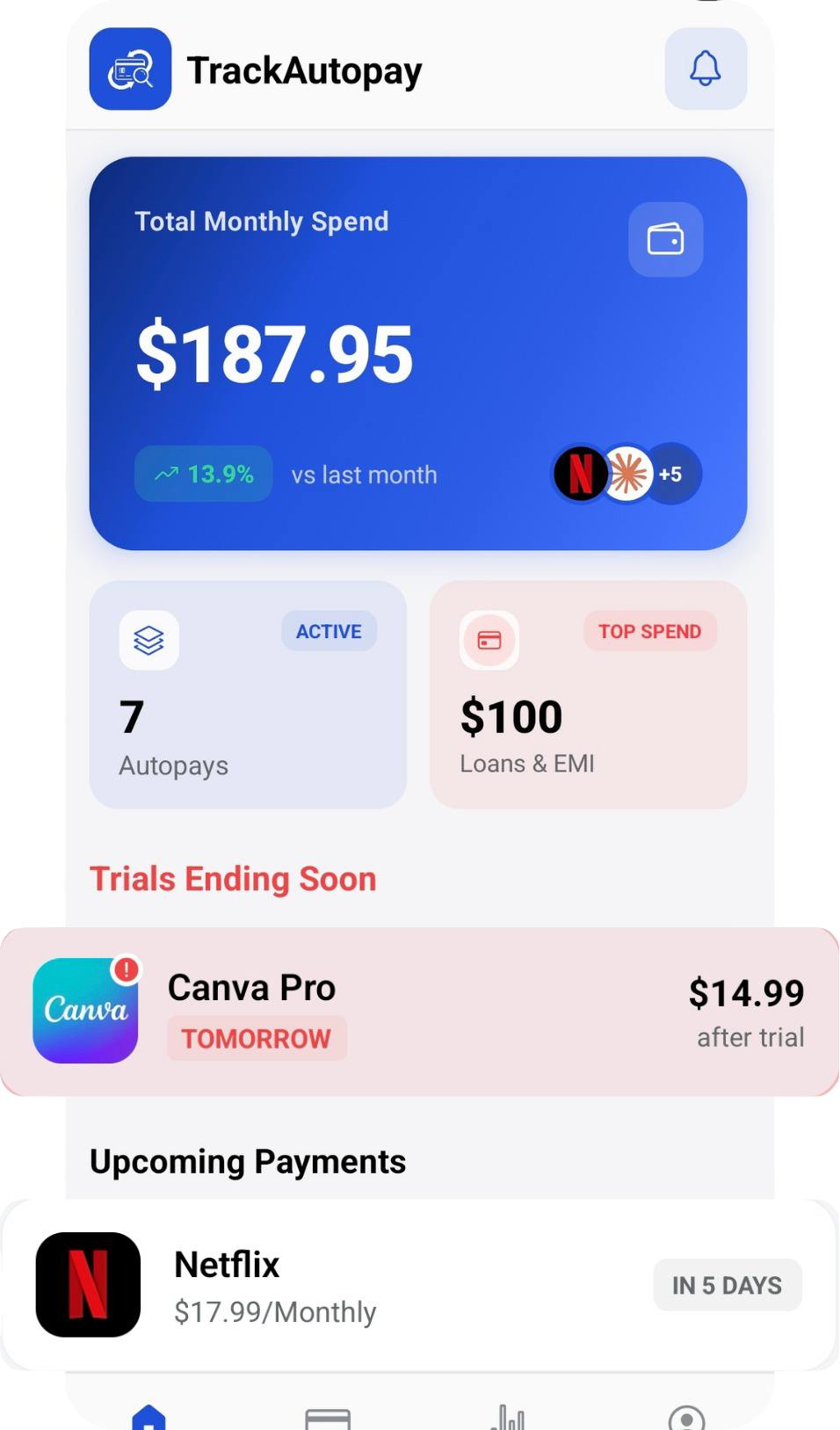
TrackAutoPay gives you one dashboard to log every subscription, including the ones billed abroad, so you can see the full picture of what you're actually paying across every currency and every card, instead of piecing it together from statements each time you decide to check.
See Every Subscription, In Every Currency
Log every subscription in one dashboard, including the ones billed abroad, so a foreign-currency fee never hides in plain sight again.