1The Autopay Decision Nobody Thinks About
When you sign up for a subscription, the checkout screen asks for a payment method, and most people just enter whatever card their phone or browser has saved. That one small choice quietly decides how several things play out later, but almost nobody stops to think about it at the time.
The two cards do very different jobs. A debit card is a direct line to money already sitting in your checking account. A credit card is a promise to pay a bank back later, using its money in the meantime. Autopay does not care which one is on file, it charges whichever card you gave it, but the two behave very differently the moment something actually goes wrong.
Note: none of this changes how autopay works on a normal day. A subscription billing $12.99 a month charges the same $12.99 whether it lands on a debit or a credit card. The difference only shows up when a charge is wrong, your balance is too low, or the card number ends up in the wrong hands.
2#1: How a Debit Card Autopay Works
A debit card is tied directly to your checking account, so when a subscription charges it, money leaves your account as part of that same transaction. There is no middleman holding the payment, it moves straight from your bank to the merchant's.
This is why a debit-funded autopay is unforgiving about your balance. If the money is not there, the payment either fails outright or, if you have opted into your bank's overdraft coverage, goes through anyway and pushes your account into the negative. Either way, the effect is immediate and touches cash you might need for something else that same week.
Quick tip: if you use a debit card for autopay, keep a buffer in that account beyond your subscription total at all times. A buffer protects you when a charge lands a day or two earlier than you expected, which happens more often than most people plan for.
3#2: How a Credit Card Autopay Works
A credit card autopay draws on a line of credit the bank already extended you, not money you currently hold. The charge appears on your statement, but you do not actually pay for it until your credit card bill comes due, usually three to four weeks later.
That gap is the entire point of using a credit card for recurring charges. A subscription can charge you today, and the money does not leave your pocket until you pay that statement, giving you a window to notice a mistake, a price increase, or a subscription you meant to cancel, before any of your own cash actually moves.
Example scenario: a subscription renews at $14.99 on the 3rd of the month, on a credit card whose statement closes on the 20th and is due on the 15th of the following month. That is close to six weeks between the charge and the day you actually have to pay for it, plenty of time to catch it on your dashboard and dispute it if it is wrong.
4#3: What Happens When a Charge Is Wrong
A wrong charge is any charge you never agreed to, a subscription that raised its price without proper notice, or one that kept billing after you cancelled. What happens next depends entirely on which card absorbed it.
On a credit card, you can dispute the charge before you have paid for it. Most issuers let you flag it on your statement and withhold payment on that specific amount while they investigate, so your own money never leaves your account in the first place.
On a debit card, the money is already gone the moment the charge posts. To get it back, you file a dispute with your bank, and if they agree the charge was wrong, they issue a provisional credit while the investigation finishes, sometimes within a few business days, sometimes longer. Until that credit lands, you are out that amount for whatever else you needed it for. For the full walkthrough on filing either kind of dispute, see our guide on disputing an unauthorized charge and getting your money back.
A credit card dispute holds a payment before it happens. A debit card dispute tries to get one back after it already did.
5#4: What Happens When You Are Short on Money
Running low on money plays out in close to opposite ways depending on the card. With a debit card, a low balance usually means the payment is declined, and depending on your bank and whether you opted into overdraft coverage, that decline can also trigger an insufficient funds fee or push your account negative. A number of banks have dropped this fee entirely in recent years, but plenty still charge it, often in the $30 range per attempt.
With a credit card, a low checking account balance does not matter at all, because the charge never touches it. The subscription still goes through, and the amount is added to your credit card balance, which you pay off, or carry with interest, when the statement is due. Nothing declines and nothing overdrafts, but the amount you owe grows the same as any other purchase on that card.
Note: a credit card autopay going through smoothly is not automatically the better outcome. If you are already carrying a balance on that card, adding a subscription to it means paying interest on that charge too, a small amount on its own, but one that adds up over a year of monthly renewals.
6#5: What Happens If the Card Number Is Stolen
A stolen or exposed card number, whether from a data breach at a merchant or anywhere else, triggers the same first step no matter which type of card it is: your bank cancels the number and reissues a new one, which is exactly the situation covered in our guide on what happens to your subscriptions when a card gets replaced.
Where the two diverge is what is at risk while the fraud is happening. On a debit card, a thief spends money directly out of your checking account, the same account you might rely on to pay rent or other bills. On a credit card, a thief spends the bank's money, not yours, and your actual cash never moves.
Under US federal consumer protection law, the two cards also carry different liability limits when fraud slips through. A credit card caps your liability for unauthorized charges at $50, and most major card networks reduce that to $0 under their own zero-liability policies. A debit card's liability depends on how fast you report it: as little as $50 if you catch it within two business days, but up to $500 if you wait longer, and potentially more after that. These figures apply to US-issued cards; check your own bank's cardholder agreement if your card was issued elsewhere.
7Debit vs. Credit for Autopay, Side by Side
The differences above add up to a fairly clear pattern once they are placed next to each other.
| What Happens | Debit Card | Credit Card |
|---|---|---|
| Whose money moves first | Yours, straight out of checking | The bank's, you repay it later |
| If a charge is wrong | Money is gone; wait for a provisional credit | You can withhold payment before you pay it |
| If your balance is too low | Can decline and trigger an overdraft or NSF fee | Still goes through; adds to your card balance |
| Liability if the number is stolen (US) | $50 within 2 business days, up to $500 after | $50 by law, often $0 under network policies |
| Effect on your day-to-day cash | Leaves your account the moment it posts | Does not touch your cash until you pay the bill |
These numbers are for US-issued cards. If your card was issued somewhere else, the exact liability limits differ, so check your own bank's cardholder agreement or your country's consumer protection rules for the equivalent figures.
8The Honest Case for Using Debit Anyway
None of this makes a credit card automatically the right choice for every subscription. A debit card autopay has a real advantage: it forces the money to leave the moment the charge happens, which is a simpler way to budget for anyone who would rather not think about a bill arriving weeks later.
A debit card also cannot let a subscription balance quietly build up the way a forgotten credit card charge can, sitting there for months while interest adds up if the statement never gets paid off in full. If you already struggle to pay a credit card bill in full every month, adding another recurring charge to it works against you, not for you.
The honest answer is that either card works fine as long as you are actually watching what gets charged to it. The protections a credit card offers do nothing for you if you never look closely enough at the statement to catch a wrong charge in the first place.
9A Simple Rule for Picking a Card
A workable rule: use a credit card you pay off in full every month for anything you can, since it gives you a dispute window and keeps a mistake from touching your cash while it gets sorted out. Use a debit card only for what you already treat as a fixed, unavoidable cost, and only if you keep enough of a buffer in that account to absorb a charge landing a day early.
Whichever card you land on for a given subscription, the protection only works if you notice a charge in time to act on it. A dispute window does not help if the charge sits unnoticed until after it closes, and a low-balance buffer does not help if you have lost track of which subscriptions draw from which account.
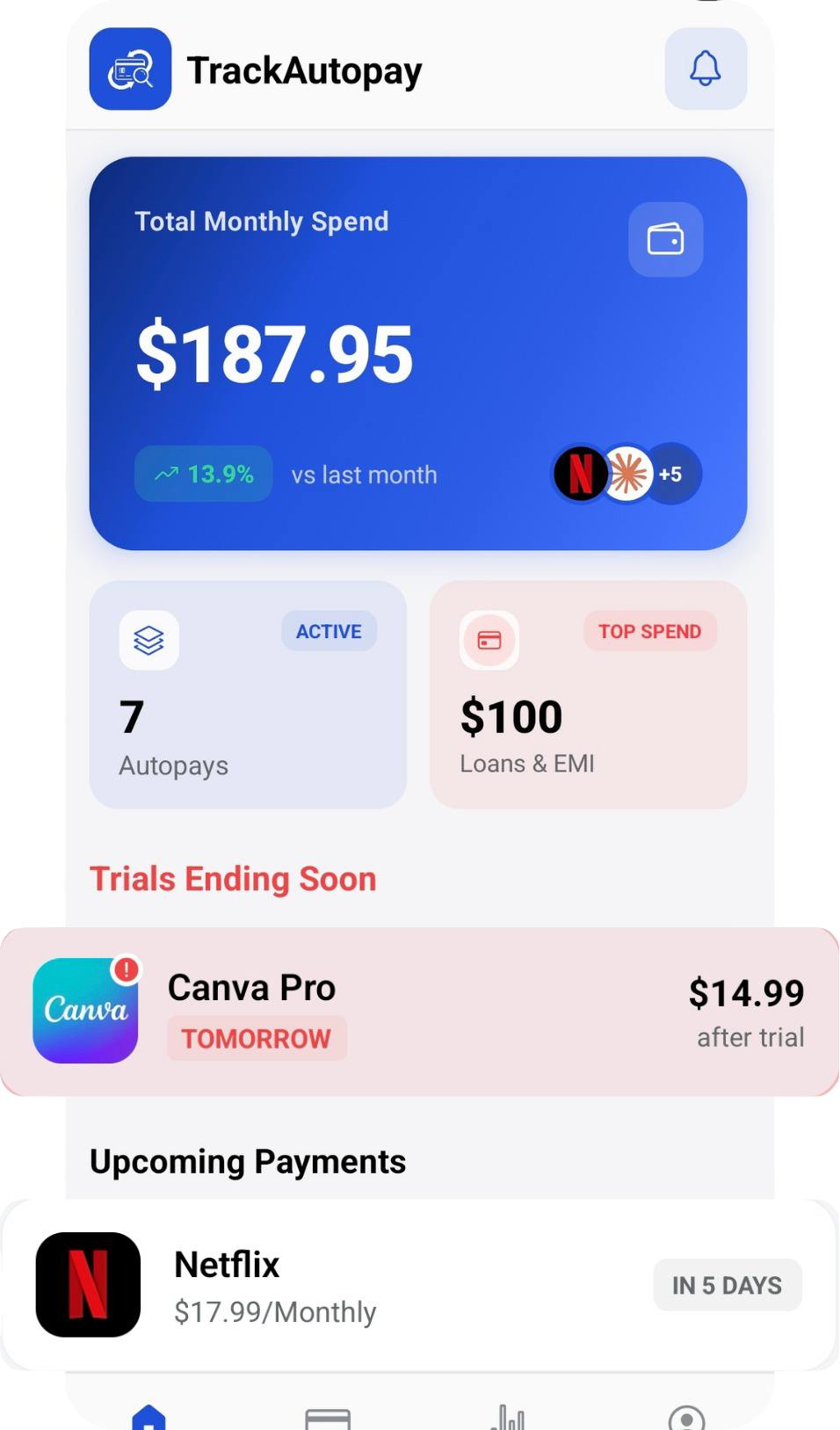
TrackAutoPay gives you one dashboard for every subscription's renewal date and amount, whether it runs through a debit card, a credit card, or a mix of both. Log which card each one uses, and you always know exactly where to look the moment a charge needs a closer look.
See Every Autopay, No Matter Which Card It's On
Track every subscription's renewal date and amount in one dashboard, debit or credit, with a reminder before each one bills.