1Autopay and Your Credit Score Are Not the Same Thing
"Autopay" is one word for a lot of very different bills: a $12 streaming subscription, a $60 phone bill, a $400 car loan payment, a gym membership. All of them can run on the same automatic charge, but a missed one does not do the same damage everywhere.
Whether a missed autopay payment can hurt your score comes down to one question: does the company you pay actually send your payment history to the credit bureaus? Most subscription and membership companies don't. Most lenders do. That single difference decides almost everything else in this guide.
Note: this guide covers US credit reporting through the three major bureaus, Equifax, Experian, and TransUnion. If you bank outside the US, your country's credit reporting system works differently, check your local bureau's rules for the exact process.
2#1: What Actually Reaches the Credit Bureaus
Credit bureaus don't watch your bank account and see every charge that goes through it. They only receive what's called furnished data, meaning the company you owe money to has an arrangement to report your account history to Equifax, Experian, or TransUnion every month. Most lenders furnish this data: credit card issuers, mortgage servicers, auto loan companies, and most private student loan servicers.
A subscription service, a streaming app, or most gyms typically has no such arrangement. It has no established pipeline to tell the bureaus you missed a payment, though it can still charge you a late fee, pause your account, or eventually send an unpaid balance to a collections agency, which is a different route onto your credit report, covered further down.
Note: a small number of opt-in services, like Experian Boost, let you add certain bill payments to your own credit file. This only affects your Experian-based score, and covers specific categories like phone, utility, and a short list of eligible streaming providers, it does not cover most subscriptions automatically.
3#2: Why a Missed Streaming or Gym Charge Usually Can't Touch Your Score
Example scenario: a streaming subscription tries to charge an expired card. The worst normal outcome is a paused account and a retry a few days later. The service has no arrangement to tell Equifax, Experian, or TransUnion that a payment was missed, so the score does not move at all.
The same logic covers most software subscriptions, streaming apps, and month-to-month memberships you can cancel any time. The company might charge a late fee, restrict access, or eventually cancel the account, but none of that is the same as a late payment showing up on a credit report.
Where this can change is a signed contract with a fixed term, like some gym memberships. If an unpaid balance on a contract like that gets sent to a collections agency, the collections account becomes its own line item on your credit report, and it can hurt your score, even though the original monthly charge never would have on its own.
4#3: Where a Missed Autopay Really Can Hurt You
Credit cards, personal loans, auto loans, mortgages, and most private student loans report your payment history to the credit bureaus every month, on time or not. If autopay fails on one of these and the payment stays missed, that is the kind of miss that can lower your score.
Federal student loans report too, and keeping autopay on there now has a direct payoff: the federal student loan autopay discount cuts your interest rate by 1 percentage point through June 2028.
A few newer categories are moving the same direction: buy now, pay later plans increasingly report to at least one bureau, and rent or utility payments can matter too, but only if your landlord or utility company has separately opted into a reporting service for that account.
Note: the account matters more than the payment method. Autopay does not create the risk by itself, it is a convenience. What creates risk is autopay failing silently on an account that reports, because a card expired, a linked bank account changed, or the balance ran too low to cover it. See our guide on what actually happens when an autopay payment gets declined for the fees and consequences that can follow.
5#4: The Grace Period Before It Becomes a "Late Payment"
A single missed payment does not turn into a mark on your credit file the instant it happens. Most credit card issuers and lenders wait until a payment is a full 30 days past its due date before they report it to the bureaus as late, which gives you a real window to catch and fix a failed autopay before it shows up anywhere.
Example scenario: an autopay for a credit card bill fails on the 5th of the month because the linked bank account was switched a week earlier. If the balance is paid by the 4th of the following month, before it crosses that 30-day mark, it typically never gets reported as a late payment at all, even though a late fee and some interest may still apply in the meantime.
Note: this 30-day window is common practice, not a guarantee across every issuer. Check your own cardholder agreement or loan terms, since a small number of accounts can report a missed payment sooner.
6#5: How Long One Missed Payment Can Follow You
If a payment does cross that 30-day line and gets reported, it does not just disappear a month later. A late payment can legally stay on your credit report for up to seven years, though its effect on your score fades well before that, the impact is largest in the first year or two and shrinks the longer your history since then stays clean.
Payment history is the single biggest ingredient in a FICO Score, worth 35% of the total, more than your credit card balances, the length of your credit history, or anything else that goes into it. That is why one 30-day-late report can cause a real, if temporary, drop, even on an account you have otherwise paid on time for years.
Payment history makes up 35% of a FICO Score, more than any other single factor that goes into it.
7Autopay Type vs. Credit Score Risk, Side by Side
The differences above add up to a fairly clear pattern once every common type of autopay is placed next to each other.
| Type of Autopay | Reports to Bureaus? | Risk if It Fails |
|---|---|---|
| Credit card bill | Yes, monthly | High, can report as late after ~30 days |
| Personal, auto, or student loan | Yes, monthly | High, same 30-day reporting pattern |
| Mortgage | Yes, monthly | High, same 30-day reporting pattern |
| Buy now, pay later plan | Varies by provider | Medium, depends on the provider |
| Rent or utility bill | Only if opted into a reporting service | Low to medium, varies |
| Streaming, software, or app subscription | No, unless sent to collections | Low, mainly a late fee or a paused account |
| Gym membership (signed contract) | No, unless sent to collections | Low normally, higher if unpaid balance goes to collections |
These are general patterns, not guarantees for every company. When in doubt, ask the company directly whether the account reports to the credit bureaus, or check your existing credit report to see if that account is already listed on it.
8How to Make Sure Autopay Never Costs You a Point
The real risk was never autopay itself, it's autopay failing quietly on an account that reports, while you find out weeks later when the damage is already showing up on your credit report. Keep a small buffer in whatever account funds a credit card or loan payment, so one low-balance day doesn't turn into a failed payment on the one type of bill that can actually hurt your score.
Note: if the card on file for a reporting account expires or gets reissued, update it right away instead of waiting for the first missed cycle to notice.
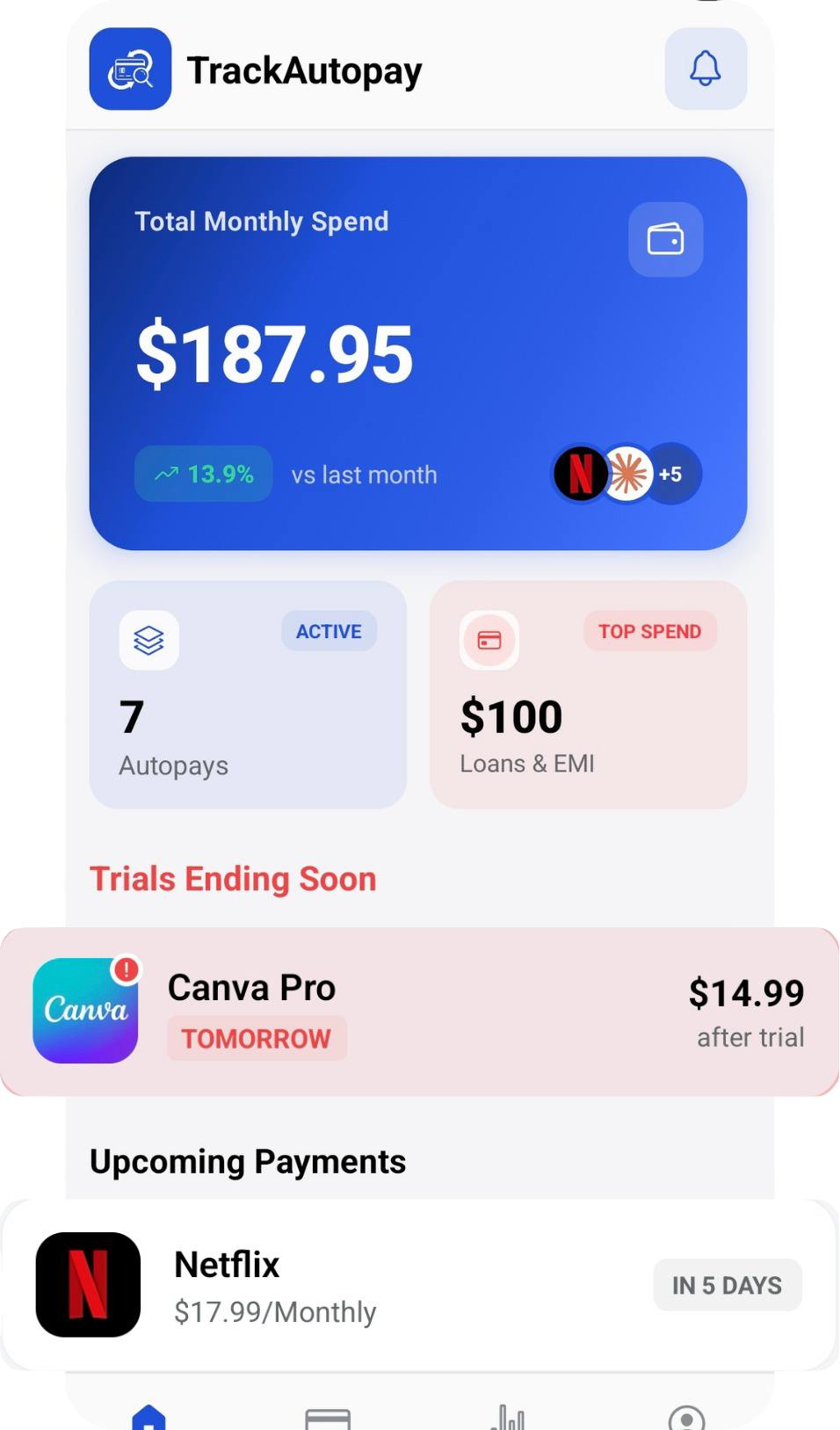
Most people don't sort their autopay list by which ones report to a credit bureau and which don't, they just have a pile of recurring charges spread across different cards and accounts. TrackAutoPay gives you one dashboard for every subscription and recurring charge, its renewal date, its amount, and which card it's tied to, so a switched bank account or an expired card gets caught before it turns into a payment that actually costs you.
Never Let a Forgotten Charge Become a Late Payment
Track every subscription and recurring charge in one dashboard, with a reminder before each one bills, so nothing fails silently.